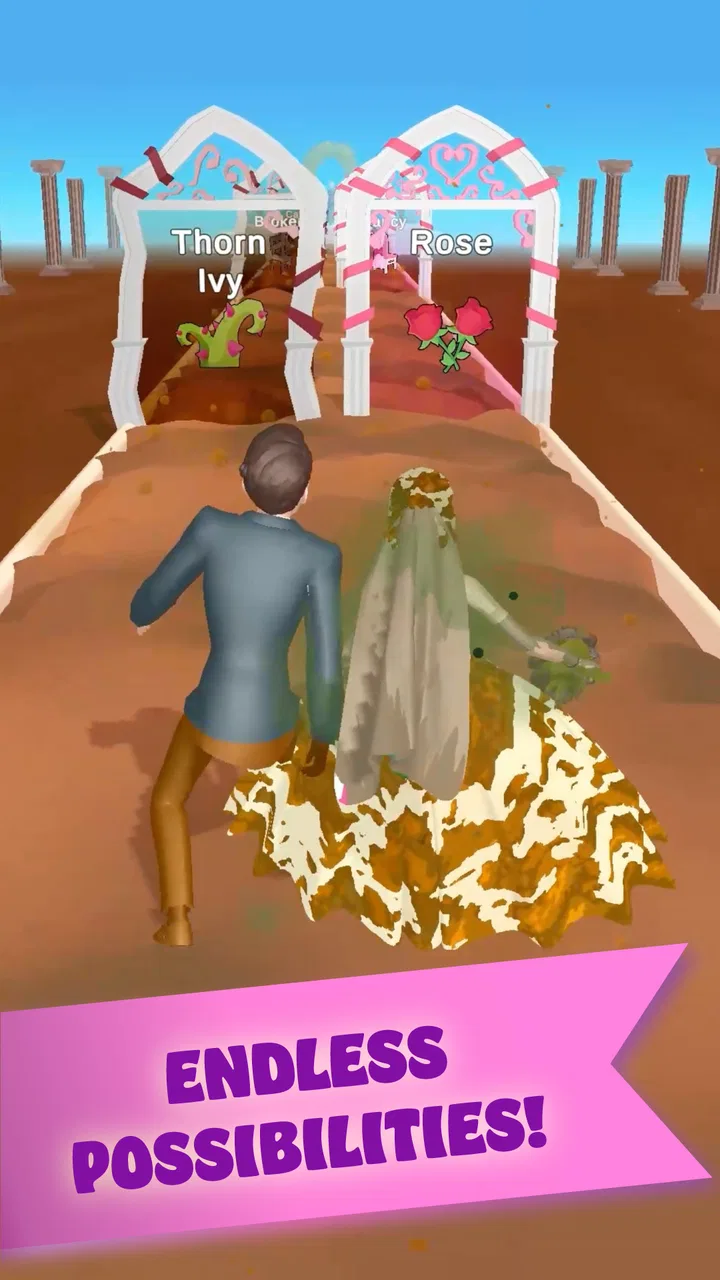
Dream Wedding: Dress & Impress
- 4.5
- Rating
- 50.00M
- Installs
- Free
- Price

 Analysis by App-foxy
I spent time with Dream Wedding: Dress & Impress as a casual fashion game, and its main appeal became clear very quickly: it turns wedding preparation into a sequence of small visual decisions. I could choose clothing, arrange a look, and work toward a romantic presentation without needing to learn a complicated control system. That makes it easy to pick up when I want something light, especially during a short break rather than a long, demanding gaming session.
What interested me most was not simply the wedding theme, but how the game asks me to judge combinations. A dress may look good on its own, yet feel less convincing once I consider the rest of the outfit. That gives the experience a gentle styling puzzle at its center. It is not a deep simulation of planning a real ceremony, and I would not choose it for strategic depth, but it does offer a pleasant loop for anyone who enjoys visual choices and gradual improvement.
How the experience reads and guides you
The presentation is built around images, outfit choices, and clear visual goals instead of long explanations. In my experience, that helps the game communicate quickly. I can usually understand what kind of decision is expected by looking at the available clothing and the current wedding context. For players who prefer learning by seeing rather than reading, this is a comfortable approach.
You May Also Like

 Pandora - Music & Podcasts
Pandora’s Music Is Easy to Start, but Harder to Recover
Pandora’s strength is its low-effort path from a seed to a station. Its weak spot is how much confidence it asks you to place in connection, setup, and quiet recovery.

 8 Ball Pool
 Is Built on Rivalries, Rematches, and Routine
A close look at the rivalries, rematches, shared routines, and unanswered safety questions that turn a quick pool match into a persistent mobile community.

 Samsung Music
’s Quiet Strength Is Playing What You Already Own
Its reach comes less from spectacle than from dependable access to a personal library. That simplicity is both the app’s strongest retention engine and its ceiling.

 AccuWeather: Weather Radar
AccuWeather Review: A Quick, Clear Forecast for Everyday Decisions
For everyday plans, the best forecast is the one you can understand quickly. AccuWeather makes rain timing, radar, and local conditions easy to act on, with a few trade-offs.

 Hill Climb Racing
Why Hill Climb Racing Still Turns Crashes Into One More Run
A tiny car, a bumpy hill and one more upgrade: Hill Climb Racing keeps resurfacing because its simple chaos makes every near-miss feel personal.

 AliExpress - Shopping App
AliExpress Makes Global Shopping Feel Personal, but Shoppers Bear the Risk
AliExpress turns a global marketplace into a pocket-sized discovery engine. Its reach is useful, its shopping loop compelling, and its trade-offs easy to miss.
More From Our News Desk
View All News


That same visual focus has an important trade-off. Fashion games depend on noticing differences between colors, shapes, and decorative details. If two options are close in tone or style, the decision can become less obvious, particularly on a smaller phone screen or in bright surroundings. I found that taking a moment to compare the full look was more useful than tapping through choices quickly. The game rewards attention to the whole outfit rather than judging one item in isolation.
Navigation feels best suited to people who already understand the conventions of mobile games. I did not need a long introduction to begin experimenting, but a first-time player who expects detailed explanations may find the experience more intuitive than instructional. That is not necessarily a flaw for a casual title; it simply means the game works better when I am willing to explore and learn from the immediate visual feedback.
One practical habit helped me: I treated each selection as part of a complete composition. Instead of asking whether a single dress was attractive, I considered whether its shape and color worked with the remaining choices. This made the game feel less random and gave me a simple personal method for making progress. It is also a useful approach for players who become overwhelmed when several attractive options appear at once.
The developer, MagicLab, has positioned the game for a broad mobile audience. Its average rating is 4.5 from around 197 thousand ratings, and its reach extends beyond a small niche, with over 50 million installs. Those figures suggest that the straightforward visual format connects with many players, although popularity alone does not guarantee that every player will find the pacing or presentation comfortable.
Readable enough for short, relaxed sessions
I think the strongest reading advantage is that the game communicates through the scene itself. I can focus on the bride, the outfit, and the surrounding presentation instead of working through dense menus. That makes it approachable when my attention is limited. For example, I could imagine playing while waiting for an appointment, with the sound off and only occasional glances at the screen.
However, visual simplicity should not be confused with universal clarity. A player with low vision may still struggle if important distinctions rely heavily on small decorative details. I would recommend increasing the phone’s general display size or using a larger screen when possible, but those are device-level adjustments rather than guarantees built into the game. Anyone who needs strong text scaling, high contrast, or spoken guidance should check the actual experience on their device before committing to longer play.
The game’s casual structure also helps reduce cognitive pressure. I was not required to remember complex rules or manage a large inventory in my head. The immediate task generally stayed close to the current styling decision. That makes it suitable for players who want a calm activity, including someone who enjoys creative choices but does not want the mental load of a strategy game.
Touch, movement, and sensory comfort
The core interaction is naturally suited to touchscreens: I select visual options and assess the result. That is easier than a game demanding rapid swipes, precise aiming, or repeated button combinations. Players with limited dexterity may appreciate the slower decision-making, especially if they can rest the phone securely instead of holding it continuously.
Still, a low-action game is not automatically effortless for every hand. Repeated tapping can become tiring, and small targets can be difficult for someone with tremors or reduced precision. I found that playing with the device supported on a table made comparisons more comfortable than gripping it in one hand. A stylus or accessibility pointer may also help some players, depending on the phone and operating system, but the game should not be assumed to support every alternative input method equally well.
Sensory comfort is another matter. A colorful wedding presentation can be appealing, yet players who are sensitive to bright visuals, animation, or changing scenes may prefer a lower screen brightness and a quieter environment. I often played with audio reduced or muted because the visual choices carried most of the experience for me. That made it easier to fit the game into shared spaces, such as a living room or a waiting area, without disturbing anyone nearby.
There is also a useful distinction between low pressure and low stimulation. The game feels casual because the decisions are approachable, but the visual design can still keep my attention active. Someone looking for a genuinely quiet, almost static pastime may prefer a simple puzzle or coloring app instead. Someone who wants gentle visual engagement without fast reflexes is more likely to enjoy this one.
For younger players, the age guidance matters. The game is rated Everyone 10+, so I would treat it as a better fit for children around that age and older rather than assuming the wedding theme makes it appropriate for every child. Adults choosing it for a family device should still consider the child’s comfort with in-app purchases and the broader habits of the household.
Where it fits into everyday life
The most convincing use case is a short, repeatable break. I could open it after finishing a small task, make a few styling decisions, and stop without feeling that I had abandoned a long story. That makes it a reasonable companion for commuting, waiting rooms, or winding down before bed, provided the screen itself does not interfere with sleep.
It also works for people who like sharing visual choices. I can imagine showing a completed look to a friend and comparing which dress or accessory feels more suitable. The conversation is simple, but that is part of the charm. The game gives two people an easy subject to discuss without requiring either person to be an experienced gamer.
For a player managing limited energy, the short-decision format may be more approachable than a game that expects long uninterrupted sessions. I could pause between choices and return later without needing to reconstruct a complicated plan. That flexibility is valuable in real life, where attention can be interrupted by work, family, or travel.
On the other hand, I would not recommend it as the main choice for someone who wants a robust creative studio. The game’s pleasure comes from selecting among presented possibilities, not from unrestricted design work. If you want to draw a dress from scratch, control every color, or build a detailed venue, a dedicated design tool or a deeper dress-up game will likely offer more freedom.
It is also less suitable for players seeking competition, narrative complexity, or demanding progression. The wedding setting provides a recognizable emotional frame, but it does not turn the game into a full relationship simulator or a detailed event-management game. I enjoyed the focused simplicity, while a player expecting a large story may find the experience too narrow.
How it compares with familiar casual alternatives
Compared with a match-three game, this title asks for visual taste rather than pattern recognition. I am not scanning the board for the fastest combination; I am considering whether the choices look coherent together. That makes the satisfaction more personal, but it can also feel less measurable. Players who enjoy clear scores and immediate tactical feedback may prefer a puzzle alternative.
Compared with a conventional dress-up app, the wedding theme gives my decisions a stronger direction. I am not simply changing clothes without context; I am working toward a specific romantic presentation. The benefit is focus. The limitation is variety: if wedding styling does not interest me, the central idea may wear thin sooner than a broader fashion game.
Compared with a life simulator, it is much easier to enter and less demanding to maintain. I do not need to manage a large virtual household or remember many relationships. That is ideal for a quick session, but it also means there is less room for long-term storytelling. The right choice depends on whether I want an instant visual activity or an evolving virtual world.
One point worth considering is the purchase model. The game is free to download, while in-app purchases are listed at $2.99 per item. I would approach those purchases carefully, especially on a shared family device. The price is easy to understand, but repeated optional purchases can change how comfortable the experience feels for someone who wants a completely no-cost game. I would set device purchase controls in advance rather than relying on willpower during play.
Practical limits I noticed
The main barrier is that visual judgment carries so much weight. A player who cannot comfortably distinguish clothing details, tones, or decorative elements may not receive the same satisfaction from the central loop. This is not a reason to dismiss the game automatically, but it is a reason to test it briefly and consider whether the device’s display settings make the choices easier to inspect.
Another limitation is input fatigue. Although the game does not demand rapid reflexes, repeated selection and comparison can still be uncomfortable for some players. Short sessions, a supported phone, and alternating hands can make a difference. If even gentle tapping is difficult, a game designed around voice control or simpler input may be a better match.
Attention can also be affected by the surrounding environment. In a crowded place, glare may hide subtle outfit differences, while background noise can make any audio feedback harder to notice. I found the game most comfortable when I could control the screen angle and play without rushing. Its casual nature makes interruptions manageable, but not every situation makes visual comparison easy.
The current version is 10.2.8, and the game runs on Android 8.0 or later. That gives it a relatively broad Android range, but anyone using an older device should check compatibility before planning to play. On a phone with a small display or limited performance, the experience may feel less comfortable than on a newer, larger handset. I would judge it by actual readability and touch response rather than by compatibility alone.
There is also a personal preference barrier: the romantic wedding framing is quite specific. Some players may enjoy the celebratory mood, while others may find it repetitive or simply unrelated to their interests. I would not recommend it to someone who dislikes dress-up themes, even if they generally enjoy casual games. A neutral decorating game would be a better alternative for players who want visual creativity without the wedding focus.
My inclusive verdict
I came away viewing Dream Wedding: Dress & Impress as an approachable, visually led casual game with a clear strength: it lets me make creative decisions without demanding fast reactions or a large time commitment. Its format can suit players who enjoy fashion, romantic presentation, and short sessions. The game also fits moments when I want something engaging but not mentally heavy.
Its support for different abilities and contexts is more practical than explicit. The simple decision loop can reduce cognitive and motor demands compared with action-heavy games, and playing without sound is a realistic option for shared or noisy spaces. At the same time, the reliance on visual detail, touch accuracy, and screen comfort creates real barriers for some players. I would not describe it as universally accessible; I would describe it as potentially manageable for many people when device settings, posture, session length, and surroundings are chosen thoughtfully.
My most useful advice is to start with a short trial rather than buying anything immediately. Check whether the clothing details are easy to distinguish, whether tapping feels comfortable, and whether the wedding theme remains enjoyable after several styling decisions. If those basics work for you, the free entry point makes it easy to keep exploring. If you need strong text enlargement, spoken interaction, highly customizable controls, or a deeper creative toolkit, another type of app may serve you better.
MagicLab’s game is best understood as a gentle styling activity, not a complete wedding planner or a demanding fashion simulator. I would recommend it to a friend who wants a colorful, low-pressure mobile game and likes making appearance-based choices. I would skip it for someone looking for complex strategy, unrestricted design, or minimal visual stimulation. For the right player, the strongest reason to try it is its easy rhythm: choose, compare, refine, and enjoy the finished look.
Because it is free and already has a large audience, it is a low-risk experiment for curious Android players, as long as the purchase settings are handled sensibly. The Everyone 10+ rating also gives families a useful starting point for deciding whether it belongs on a child’s device, while still leaving room for an adult to supervise spending and screen habits. My final impression is positive but specific: this is a friendly casual dress-up experience whose inclusiveness depends less on complexity and more on whether its visual presentation works comfortably for you.
FAQs for Dream Wedding: Dress & Impress
01What is Dream Wedding: Dress & Impress about?
Dream Wedding: Dress & Impress is a simulation game where players can design and plan their dream wedding. The app allows you to choose everything from the perfect bridal gown and groom's attire to the venue and decorations. You'll even get to manage guests and create a memorable event with your creative touch.
02Is Dream Wedding: Dress & Impress free to play?
Yes, Dream Wedding: Dress & Impress is free to download and play. However, it offers in-app purchases that enhance the gaming experience. These may include premium wedding dresses, exclusive venues, and decorative items. Be mindful of these optional purchases, especially if you're monitoring spending.
03What platforms is Dream Wedding: Dress & Impress available on?
Dream Wedding: Dress & Impress is available for both Android and iOS devices. You can download it from the Google Play Store for Android or the Apple App Store for iOS. Ensure your device meets the minimum system requirements to enjoy smooth gameplay without any technical issues.
04Does Dream Wedding: Dress & Impress require an internet connection?
While the game can be played offline, certain features such as updates, accessing online content, or sharing your wedding creations on social media require an internet connection. Playing online also ensures you have access to the latest features and any new content added to the game.
05Can I customize characters and venues in Dream Wedding: Dress & Impress?
Absolutely! The game offers extensive customization options for both characters and venues. You can personalize the bride and groom's attire, hairstyle, and accessories. Additionally, you can select and decorate various venues to match your wedding theme, making each event unique and personal.
Pros
- Wide variety of dress options.
- Intuitive user interface.
- Engaging storyline progression.
- Regular updates with new content.
- Supports offline play mode.
Cons
- In-app purchases can be pricey.
- Limited customization for characters.
- Some tasks feel repetitive.
- Occasional ads disrupt gameplay.
- Requires stable internet for updates.

Dream Wedding: Dress & Impress
Gallery